-
2018-12-07
-
Industry Trends
Standardizing Industry Practices and Taking the Lead: Nine Leading Enterprises Jointly Sign the "Zhejiang Province Residential Distributed Photovoltaic Industry Self-Discipline Convention for Promotion and Application"
Recently, the Zhejiang Provincial Energy Bureau officially issued the "Service Guidelines for Residential Rooftop Distributed Photovoltaic Power Generation Projects." This guideline, jointly compiled by the Provincial Energy Bureau, the Provincial Photovoltaic Industry Technology Innovation Strategic Alliance, the Hangzhou Photovoltaic Association, the Provincial Renewable Energy Association, the Provincial Power Company, and some photovoltaic enterprises, aims to promote the high-quality construction of residential rooftop photovoltaic projects throughout the province. It is understood that this is the first standardized guideline in China covering the entire process of residential photovoltaic applications.
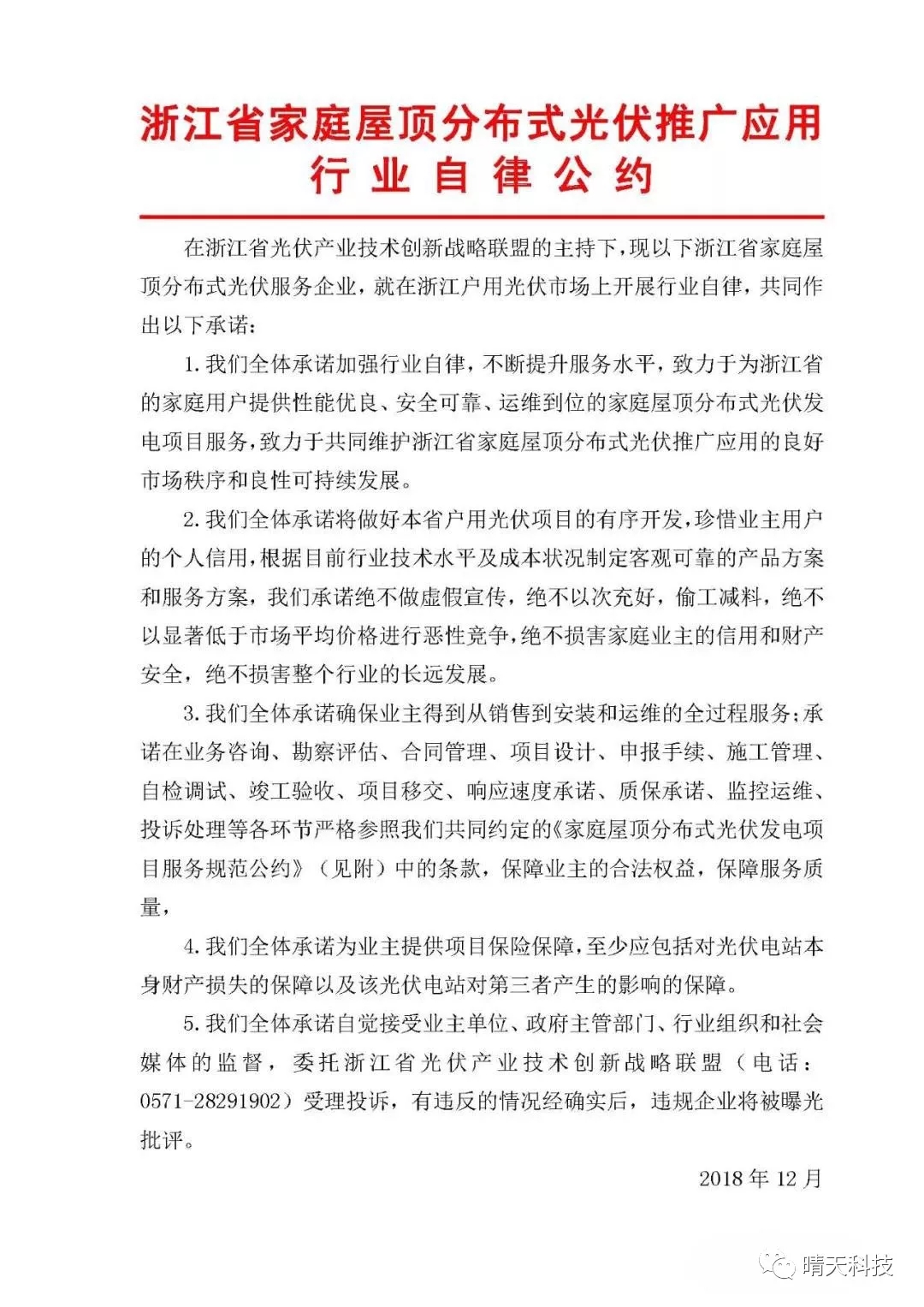
To implement the "Guidelines" across the province, nine photovoltaic companies—Qingtian Solar, Chint Energy, Sunny Energy, Foster Solar, Zhejiang Infrastructure Investment New Energy, Viven Hezhong, Yuteng New Energy, Orient Sunrise (DianDian), and Yuesheng New Energy—jointly signed and released the "Zhejiang Province Household Rooftop Distributed Photovoltaic Industry Self-Discipline Convention" in accordance with the provisions of the "Guidelines." They took the lead in publicly committing to strengthening industry self-discipline and jointly maintaining market order and sound development in the promotion and application of household rooftop distributed photovoltaic systems in Zhejiang Province. The "Convention" makes the following key commitments:
1. Ensure the orderly development of residential photovoltaic projects in the province, cherish the personal credit of homeowners, formulate objective and reliable product and service plans based on the current industry technology level and cost situation, never engage in false advertising, never use inferior materials or cut corners, never engage in vicious competition with prices significantly lower than the market average, never damage the credit and property security of homeowners, and never harm the long-term development of the entire industry.
2. Ensure that owners receive full-process services from sales to installation and operation and maintenance. In all aspects, including business consultation, survey and evaluation, contract management, project design, application procedures, construction management, self-inspection and commissioning, completion acceptance, project handover, corresponding speed commitment, quality assurance commitment, monitoring and operation and maintenance, and complaint handling, we will strictly follow the terms of the "Convention" to protect the legitimate rights and interests of owners and ensure service quality.
3. Provide project insurance coverage for the owner, which should at least include coverage for property damage to the photovoltaic power station itself and coverage for the impact of the photovoltaic power station on third parties.
4. We will consciously accept the supervision of owners, government departments, industry organizations and social media, and entrust the Zhejiang Photovoltaic Industry Technology Innovation Strategic Alliance (Tel: 0571-28291902 ) to handle complaints. If any violations are confirmed, the violating companies will be exposed and criticized.
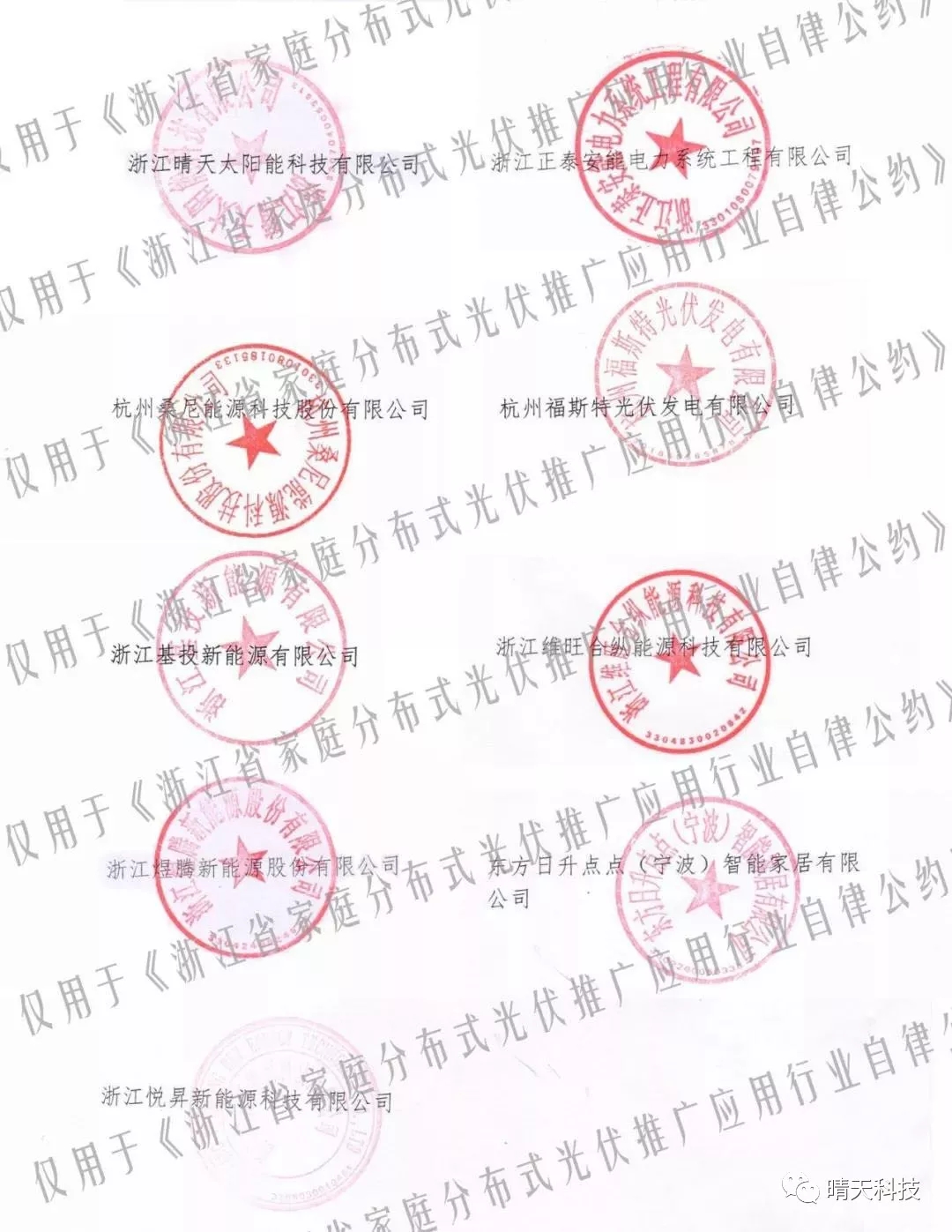
• List of participating companies in the "Zhejiang Province Residential Distributed Photovoltaic Power Generation Promotion and Application Industry Self-Discipline Convention" (in no particular order):
Zhejiang Qingtian Solar Energy Technology Co., Ltd.
Hangzhou Sunny Energy Technology Co., Ltd.
Zhejiang Infrastructure Investment New Energy Co., Ltd.
Zhejiang Yuteng New Energy Co., Ltd.
Zhejiang Yuesheng New Energy Technology Co., Ltd.
Zhejiang Chint Aneng Power System Engineering Co., Ltd.
Hangzhou Foster Photovoltaic Power Generation Co., Ltd.
Zhejiang Weiwang Hezhong Energy Technology Co., Ltd.
Oriental Sunrise DotDot (Ningbo) Smart Home Co., Ltd.
Appendix:
Service Standards Convention for Residential Rooftop Distributed Photovoltaic Power Generation Projects
Chapter 1 General Provisions
Article 1. In order to strengthen and improve the self-regulatory mechanism of the household distributed photovoltaic industry in our province, standardize the service process and behavior of household rooftop distributed photovoltaic power generation projects, improve service quality and capabilities, create a harmonious service environment, and promote the healthy and sustainable development of the industry, this industry service standard self-regulatory convention is hereby formulated.
Article 2 Service providers shall comply with national laws, regulations, and industrial policies, implement relevant national, industry, and local standards, and meet the following qualification requirements:
(i) Service companies should be registered with the industry and commerce administration department, have independent legal person status, and have no serious bad credit or illegal records.
(ii) Service companies should have fixed office space and after-sales service outlets in the city or county (city) where the project is located, and the companies themselves should have clear service process specifications.
(iii) Service companies should be equipped with full-time technical personnel in the field of photovoltaic power generation, and installation and operation and maintenance personnel should have undergone professional technical training and possess technical capabilities that match the service content.
Article 3. Household rooftop distributed photovoltaic power generation projects should be legal and compliant projects that meet planning requirements and should be in harmony with the surrounding environment.
Article 4 Owners of residential rooftop distributed photovoltaic power generation projects shall receive full-process services in terms of sales, installation and operation and maintenance.
Article 5 It is advisable to insure the project to reduce losses such as damage to electrical appliances or fires caused by lightning, as well as property and personal injury losses caused by various severe weather conditions.
Chapter Two: Sales Service Standards and Self-Discipline
Article 1. Sales service companies shall comply with the following provisions when providing business consultation to project owners:
(i) The project owner should be clearly informed of the amount and duration of government subsidies at all levels, and relevant policy documents should be provided to the project owner.
(ii) It should be clearly informed that the power generation of the distributed photovoltaic power generation project on the roof of the household is related to the ambient temperature, the orientation of the roof, the tilt angle and the degree of shading, and decreases with the annual degradation of the components.
(iii) The power generation of the project should not be over-publicized. According to the solar irradiance in Zhejiang Province, the annual power generation per peak watt generally does not exceed 1.2 kWh, and is usually between 0.9 and 1.15 kWh.
(iv) The legality and compliance of the roof should be understood and confirmed first, and the investment risks of illegal and unauthorized construction should be clearly informed to the project owner.
(v) Project owners should be informed of the risks associated with using the photovoltaic loan model. Even with zero down payment, project owners bear credit responsibility, which will affect their credit index in the future. Due to weather changes, the monthly power generation subsidy may be insufficient to repay the loan. Service companies should clearly inform project owners of these risks.
(vi) Project owners should be clearly informed of the potential risks to electricity safety and lightning protection associated with the distributed photovoltaic power generation project on their residential rooftops.
(vii) A Project Proposal should be provided to the project owner, including but not limited to the project's technical solutions, key product and equipment selection, and quality assurance. If the project adopts a loan model, the Project Proposal should also include loan calculations.
Article 2. Sales and service enterprises shall strictly comply with the provisions of the Contract Law of the People's Republic of China and other relevant laws and regulations when signing sales and installation service contracts with project owners, and the following clauses shall be followed in the signing of the contracts:
(i) The service contract should include: project content, implementation period, installation quality, and acceptance standards; provide a photovoltaic power generation system configuration: a list of main equipment and materials and relevant quality certifications; and clearly define the warranty period for the photovoltaic power generation system and main equipment. Key equipment products used in the project, such as photovoltaic modules and grid-connected inverters, should have certification certificates issued by a third-party certification body recognized by the National Certification and Accreditation Administration. Complete sets of metering boxes and components should have passed " 3C " certification, possess formal product performance test reports, and have the conditions for verifying and tracing product quality.
(ii) The service contract should clearly specify the costs required for the project installation. The service provider should issue a formal invoice to the project owner in accordance with the contract, and the invoice amount should be consistent with the contract amount.
(iii) The service contract should clearly define the ownership of the monitoring equipment and the payment of traffic fees.
(iv) For projects using a loan model, the service provider shall assist the project owner in handling the relevant procedures for the project loan.
Article 3 Sales and service enterprises shall assist project owners free of charge in applying to the power supply company for project access to the system and for grid connection acceptance after project completion.
Article 4 Sales and service companies shall conduct self-inspection of the system after the project is completed and prepare a system acceptance report.
Article 5 For projects that fail the grid connection acceptance by the power supply company, the sales and service enterprise shall implement rectification according to the rectification plan until the grid connection acceptance is passed.
Article 6. Upon completion of project construction and grid connection, the sales and service company shall, in accordance with the provisions of the project contract, transfer project documents and provide training, and comply with the following terms:
(i) Project data archives should include basic information, drawings, traceable product numbers of photovoltaic modules and grid-connected inverters, distribution box codes, installation records, equipment and system commissioning records, equipment and material certificates of conformity, warranty cards and certification reports, system acceptance reports, grid connection acceptance reports, monitoring accounts, etc.
(ii) The project owner shall be provided with maintenance manuals, usage and safety instructions and manufacturer's equipment warranty certificates.
(iii) Assistance should be provided to project owners in installing the monitoring APP on their mobile terminals, and it should be ensured that project owners learn how to use the mobile terminal devices and can view the project operation status and power generation data; for the part involving self-operation and maintenance by project owners, the basic daily operation and maintenance operations, safety precautions, usage precautions and emergency handling measures should be clearly explained.
(iv) The project owner and rooftop owner should be clearly informed that: the rooftop photovoltaic system is an electrified system and should be operated and maintained by professionals. The project owner and rooftop owner should not operate it directly; shading will seriously affect the power generation revenue, and the rooftop owner should not dry items on the components; attention should be paid to the possible impact on the power generation of the project after a power outage to avoid revenue loss; network traffic fees for the use of monitoring equipment should be paid in a timely manner.
Chapter Three: Self-Discipline in Installation Service Standards
Article 1 Installation service companies shall adhere to the following terms during the site survey and assessment phase for property owners:
(i) Basic information about the project should be collected, and the building layout, overall condition of the roof and surrounding environment should be surveyed on-site . The roof type, structural design, structural materials and structural durability, construction and strength of the installation parts of the existing building should be checked in accordance with GB 50292, and the safety of the building structure and load-bearing capacity should be assessed accordingly.
(ii) The diameter of the building's incoming line should be checked, and its ability to withstand the peak operating current of the photovoltaic power generation system should be checked and calculated.
(iii) If the installation service company finds the following situations during the project survey, the roof is not suitable for installation or the installation area should be reduced:
1) The building service life of brick-concrete structure houses has exceeded 25 years, and the building service life of brick-wood structure houses has exceeded 25 years.
2) Buildings with large areas of shading around the roof.
3) Buildings whose roofs (including tiles, tile load-bearing structures, and roof platforms) have been in disrepair for many years and pose structural and other safety risks.
4) Buildings with a large amount of dust on the roof or surrounding area, or buildings classified as Class A, Class B, or corrosive gases.
(iv) After the site survey and assessment, a written "Project Planning Scheme and Feasibility Statement" should be submitted and fully communicated and confirmed with the project owner. The scheme should include, but is not limited to:
1) Design scheme: installed capacity, power generation life, grid connection voltage level, grid connection point location, roof layout diagram, wiring diagram, and schematic diagram of the installation location of inverter and distribution box.
2) Equipment selection: Provide information on the manufacturers, models, specifications, and materials of major materials such as components, inverters, brackets, distribution boxes, and cables.
3) Profitability calculation: Based on the orientation, tilt angle, and shading conditions of the components, power generation and investment returns are calculated.
4) Project commitments regarding service content and processes within the project's service life.
(v) Before construction, the project owner should be fully informed about the details of construction management, system operation and maintenance.
Article 2. Installation service companies shall comply with the following provisions during the design phase of residential rooftop distributed photovoltaic power generation projects:
(a) The project is designed to operate for no less than 25 years.
(ii) The project design should meet the following safety requirements:
1) Lightning protection grounding measures and grounding resistance requirements should be comprehensively considered, and the grounding resistance should meet the lightning protection design standards.
2) The buildings should be classified according to the survey and assessment data to verify the feasibility and structural safety of the project.
3) When the building has a pitched roof structure, the photovoltaic modules should be installed along the slope, and the modules should not exceed the highest point of the roof where they are installed. The vertical height between the surface of the module array and the roof where it is installed should not exceed 30cm . When the building has a flat roof structure, the maximum height of the photovoltaic modules and the distance between the roof and the roof should not exceed 1.5m .
4) The support structure and its components for photovoltaic power generation systems should have sufficient strength, rigidity, and corrosion resistance, and be reliably connected and anchored to the main structure. Aluminum alloy is preferred for pitched roof supports, while steel is preferred for flat roof supports. Effective anti-corrosion measures should be taken for carbon structural steel and low-alloy high-strength structural steel.
5) The inverter should be installed in a well-ventilated location, avoiding rain and direct sunlight as much as possible.
(iii) The project design should meet the following aesthetic requirements:
1) Photovoltaic modules should be arranged according to the principles of centralized priority, neat and symmetrical arrangement, harmonious color scheme, and aesthetic uniformity.
2) When installing photovoltaic (PV) power generation systems on the rooftops of homes in areas such as main entrances, important gathering plazas, and scenic spots, the installation method and color scheme should be strictly controlled, and an analysis of the visual impact after installation should be conducted. Full-coverage PV modules, tile-shaped PV modules, or black-gray PV modules are recommended.
3) When installing a photovoltaic power generation system on a flat roof, the photovoltaic modules should be properly enclosed using building components such as parapet walls to ensure the aesthetics of the building structure.
4) The roof layout should be designed in detail based on the current condition of the building roof and the number of photovoltaic modules to be installed: the dimensions of the module layout should be shown on the construction drawings, as well as the dimensions between the modules and the building edges, between the modules, and between the modules and obstacles. Electrical wiring diagrams and electrical schematic diagrams should be designed to ensure the aesthetics of the building structure.
Article 3 Installation service companies shall strictly manage the construction of residential rooftop distributed photovoltaic power generation projects and comply with the following provisions:
(a) Construction insurance should be purchased for the installers.
(ii) The construction organization and management of the project site shall be carried out in strict accordance with the time limit stipulated in the contract. The main contents include the allocation of personnel, preparation of materials, and management of construction quality, cost, progress, safety and environment.
(iii) Inspection records shall be kept for all equipment and raw materials used in the construction process upon arrival at the site to ensure consistency with the equipment and materials list attached to the contract. Any changes to materials shall be confirmed by the project owner's signature.
(iv) Safety protection measures should be implemented at each stage of on-site construction, the construction site should be kept clean and the roads should be kept clear, fire protection measures should be implemented, and relevant regulations on regional engineering construction management should be met.
(v) The safety of the rooftop owner and construction workers shall be ensured during on-site construction. The following requirements shall be met during the project construction process:
1) Construction workers should wear safety ropes, non-slip shoes and safety helmets.
2) Construction workers are strictly prohibited from carrying out construction work in rainy, snowy, or windy weather.
3) Construction workers should take precautions against heatstroke during hot weather.
4) Construction personnel should carry installation drawings and strictly follow the design plan for construction.
5) Safety warnings should be set up in the construction area, and the hoisting area should be guarded by designated personnel.
6) Construction personnel should handle photovoltaic modules with care and are strictly prohibited from stepping on the modules or engaging in rough construction during the construction process.
7) Construction personnel should use professional installation tools, and professional tools should be used for the installation of photovoltaic connectors.
8) Construction workers should take care to protect the roof during construction. After completion, construction workers should check whether the tiles are damaged or not, and check the stability of the connection between the tiles and the mounting brackets.
9) Construction workers should conduct construction in a civilized manner and clean up the site after construction is completed.
10) The project should reserve maintenance access to ensure smooth operation of photovoltaic module cleaning, system maintenance and repair.
Article 4. After the project installation is completed, the construction team shall conduct system self-inspection and debugging in accordance with the relevant standards and specifications stipulated in the contract. The debugging content includes:
(a) String voltage detection: Check whether the voltage of the entire string meets the specified requirements.
(ii) Start the inverter and check if the system is generating electricity normally.
(iii) Monitor and debug, check whether the data transmission and display are normal. After the debugging is completed, the installation team should inform the operation and maintenance service company and the project owner at the same time.
Chapter Four: Self-Discipline in Operation and Maintenance Services
Article 1. Operation and maintenance service companies should clearly label the following information:
(i) Warning signs against electric shock should be set up in prominent locations where people may come into contact with or approach the photovoltaic power generation system.
(ii) The outer casing of the system distribution box should clearly indicate the photovoltaic system power, the name of the sales or installation service unit and the after-sales service telephone number, and the project grid connection date should be indicated inside the box.
Article 2. Operation and maintenance service companies shall assign corresponding professional and technical personnel and commit to response speed to project owners.
(a) For projects that require on-site emergency fault handling during the operation and maintenance period, the project owner should be provided with 24- hour hotline service and emergency contact information service.
(ii) The response time of operation and maintenance service companies should not exceed 1 hour, on-site service should not exceed 24 hours, and emergency on-site service should not exceed 8 hours.
(iii) If the project owner reports equipment damage or malfunction, after confirmation , maintenance personnel should be arranged to conduct on-site inspection and maintenance within 2 working days.
Article 3 Operation and maintenance service companies shall provide power monitoring and proactive operation and maintenance services to project owners, and shall comply with the following terms:
(a) Implement remote monitoring for residential rooftop distributed photovoltaic power generation projects and grant remote operation and monitoring permissions to project owners.
(ii) The monitoring system should be able to monitor and dynamically analyze power generation online.
(iii) In addition to power consumption monitoring, proactive operation and maintenance services for fault alarm handling should be provided. When the building's power supply is interrupted, the project owner should be promptly informed of the impact of the power outage on the project's power generation. Furthermore, abnormal power consumption should be remotely monitored, and the abnormal power generation after the power outage should be proactively notified.
(iv) It is advisable to provide proactive reminders for power generation, troubleshooting, subsidy disbursement, and loan repayment schedules for project owners under the loan model.
(v) Necessary cleaning should be arranged as needed, depending on the changes in power generation.
Article 4. The operation and maintenance service company shall provide the following quality assurance commitments to the project owner:
(a) The warranty period for all equipment and materials shall be calculated from the date of grid connection.
(ii) In principle, the warranty period for photovoltaic power generation systems should not be less than 3 years.
(iii) The warranty period for photovoltaic modules shall not be less than 10 years, and the warranty period for power-limited modules shall not be less than 25 years; the warranty period for grid-connected inverters shall not be less than 10 years; and the warranty period for cables and distribution boxes shall not be less than 3 years.
Article 5 The operation and maintenance service company shall provide complaint and dispute resolution services to the project owner and comply with the following terms:
(a) A service hotline should be established and the channels and methods for accepting complaints should be publicized.
(ii) A complaint management system should be established to standardize the complaint handling process. A comprehensive set of regulations for handling complaints from project owners should be established, including at least: the scope of complaint handling, the responsible department and its duties, the complaint handling process, the time limit for complaint handling, and the results.
(iii) When a complaint is received from the project owner , the responsible party shall contact the project owner within 24 hours and handle the matter within 3 working days, unless otherwise agreed upon with the project owner.
Chapter 5 Industry Regulation
Article 1 The competent government departments and local industry associations are the supervisory bodies for the implementation of this convention. They have the right to conduct spot checks on projects. If any major quality problems are found, the competent government departments shall order rectification and include the project service companies that have repeatedly failed to rectify the problems in a blacklist and incorporate them into the credit system management.
Article 2 If a project has any illegal or unauthorized construction issues, the project owner shall bear the responsibility and shall rectify or demolish them.